Breaking the Cycle:
Hello Everyone! This last week I have been supporting clients who have found themselves stuck in rumination which has really robbed their self compassion from their week.
Rumination is hard and and we’ve all been there — replaying a conversation, a mistake, or a moment of pain over and over in our minds. This mental loop, known as rumination, can feel like a trap. While reflection helps us learn, rumination keeps us stuck. It’s the difference between growth and stagnation.
What Is Rumination?
Rumination is the repetitive focus on negative thoughts, often about the past or perceived failures. It’s not problem-solving — it’s problem-replaying. Research shows that rumination is strongly linked to:
- Increased risk of depression and anxiety
- Impaired problem-solving and decision-making
- Sleep disturbances and emotional exhaustion
When we are stressed and fatigued, rumination can quietly erode resilience. It’s a mental habit that feels productive but rarely is.
Why It’s So Hard to Stop
Rumination hijacks the brain’s default mode network — the system active when we’re not focused on a task. It’s like background noise that grows louder when we’re tired, alone, or emotionally triggered. The brain seeks resolution, but rumination rarely provides it.
So how do we interrupt the cycle?
Positive Distraction: A Gentle Exit Strategy
One powerful way to shift gears is through positive distraction — intentionally redirecting your attention to affirming, grounding thoughts. This isn’t toxic positivity. It’s a compassionate intervention.
Try this: when you notice yourself spiralling, pause and read (or write) a list of positive statements about yourself. These aren’t empty affirmations — they’re reminders of your strengths, values, and worth.
Here’s a starter list you can personalize:
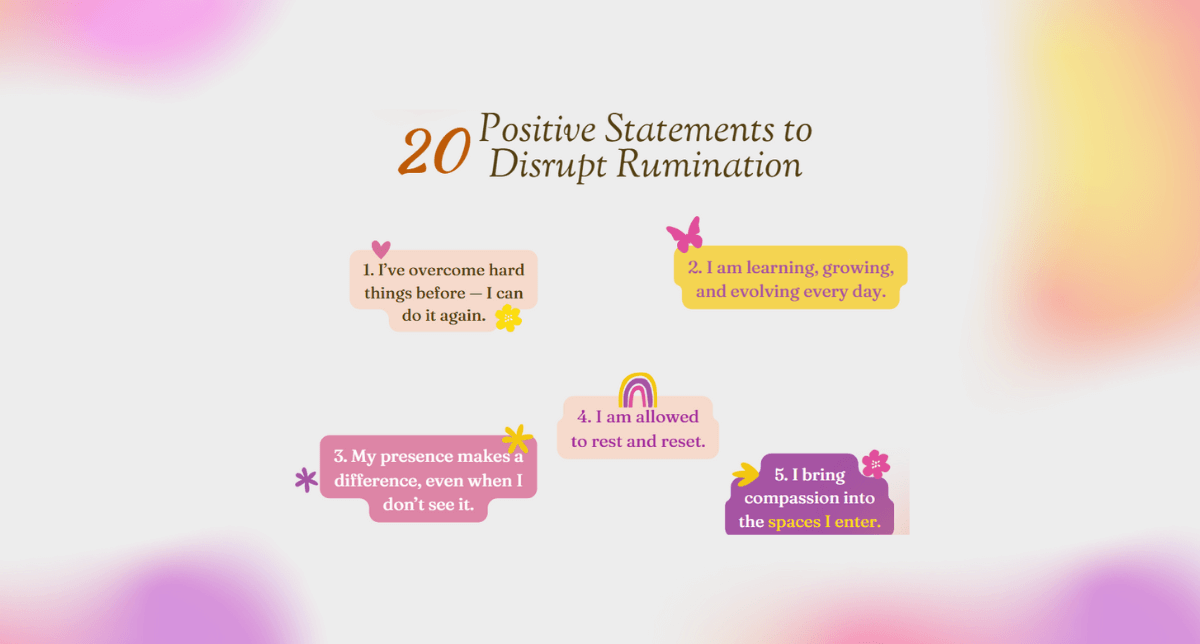
20 Positive Statements to Disrupt Rumination
- I’ve overcome hard things before — I can do it again.
- I am learning, growing, and evolving every day.
- My presence makes a difference, even when I don’t see it.
- I am allowed to rest and reset.
- I bring compassion into the spaces I enter.
- I am more than my mistakes.
- I am worthy of kindness — from myself and others.
- I choose progress over perfection.
- I am resilient, even when I feel fragile.
- I have helped others heal — that matters.
- I am creative in how I solve problems.
- I am not alone in this experience.
- I am allowed to feel and still move forward.
- I am proud of how far I’ve come.
- I am a work in progress, and that’s okay.
- I bring light to difficult moments.
- I am capable of change and growth.
- I am enough, just as I am.
- I am learning to treat myself with gentleness.
- I am here, and that is a victory.
How to Use This List
- Print it and keep it in your workspace or journal. (see downloadable pdf)
- Read it aloud when you feel stuck.
- Highlight the ones that resonate most — ADD your own Positive Statements about you!
- Use it as a grounding tool in mentoring, coaching, or team debriefs.
Final Thoughts
Rumination thrives in silence and shame. Positive distraction is a way to speak back — with truth, compassion, and hope. You don’t have to fight your thoughts. You can gently guide them elsewhere.
Let this list be your lifeline when the mental loop begins. You are not your rumination. You are your resilience.
Reference List
Layous, K., Kumar, S. A., Arendtson, M., & Najera, A. (2023). The Effects of Rumination, Distraction, and Gratitude on Positive and Negative Affect. Journal of Personality and Social Psychology, 124(5), 1053–1078.
Zhao, J.-J., Yu, X.-L., & Lu, Y.-J. (2025). Rumination Harmfulness: A Three-Level Meta-Analysis of the Relationship Between Rumination and Mental Health Among Adolescents. International Journal of Cognitive Behavioural Therapy.