In healthcare and education, stress isn’t just a personal experience—it’s a shared reality. Whether you’re in a bustling ED or a remote classroom, the pressures and complexities of care and education, leave their mark. But what if we could name those marks, map them, and use them to build stronger, more compassionate teams?
That’s where the Stress Signature Model comes in.
What Is a Stress Signature?
Your stress signature is the unique way your body, mind, and behaviour respond to pressure. Like a fingerprint, it’s shaped by your biology, personality, history, and context. Some of us go quiet. Some get snappy. Some over-function. Some shut down.
Recognizing your signature isn’t about judgment—it’s about awareness. And when teams share their signatures, something powerful happens: we move from reactivity to empathy, from isolation to connection.
The Framework: Five Elements of a Stress Signature
- Baseline Awareness
What does “regulated” feel like for you? Calm isn’t the same for everyone. Knowing your baseline helps you notice when you’ve drifted.
- Early Warning Signs
These are the subtle cues—tight shoulders, racing thoughts, irritability—that signal rising stress. Catching them early is key.
- Escalation Patterns
Do you fight, flee, freeze, or fawn? Mapping your dominant stress response helps you understand your impact on others—and theirs on you.
- Recovery Strategies
What brings you back to baseline? Movement, connection, boundaries, breath—your toolkit matters.
- Contextual Triggers
What reliably activates your stress signature? Time pressure? Conflict? Emotional labour? Naming triggers builds preparedness.
Stress Signatures in Teams
When teams explore their stress signatures together, they build psychological safety. They learn:
- How to spot each other’s early signs
- What support looks like (and what doesn’t)
- How to de-escalate collectively
- That stress is human—not a flaw, but a signal
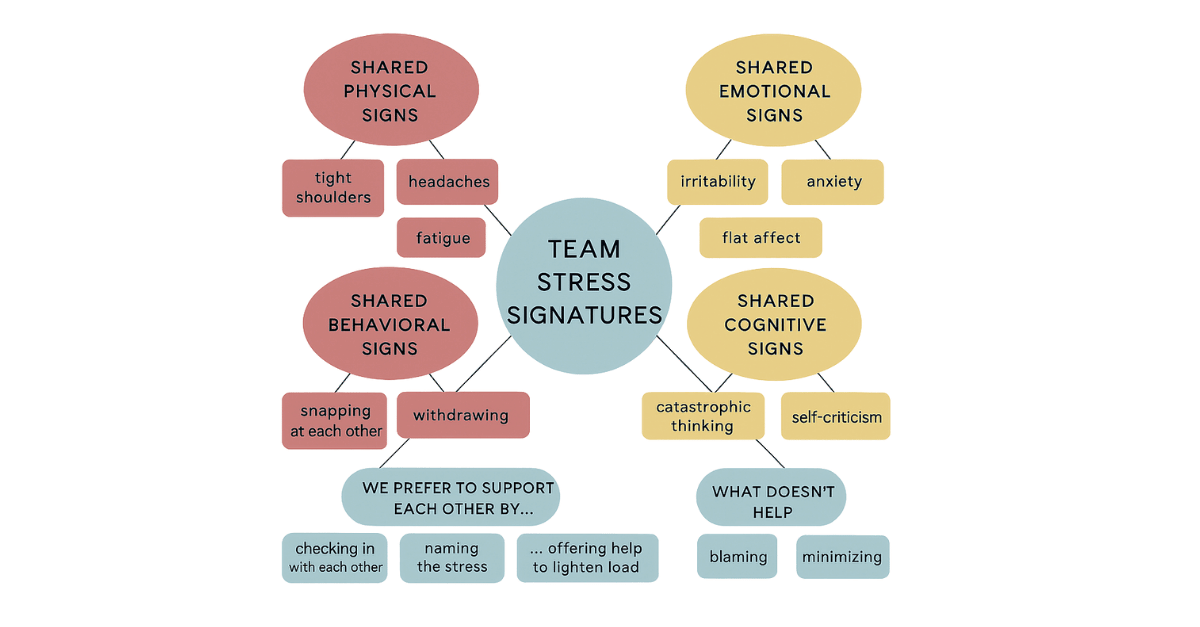
In workshops, I use a Team Stress Map—a visual tool that captures shared patterns and preferred support strategies. It’s simple, powerful, and deeply human. Teams see themselves reflected in each other. They laugh. They nod. They soften.
What Teams Say
“I didn’t realize how much I withdraw when I’m stressed. Seeing it on the map helped me name it—and ask for space without guilt.” — Rural Nurse, NSW
“Many of us ticked ‘fight’ as our default. No wonder our meetings felt tense. Now we check in before we dive in.” — Allied Health Team, QLD
Try It With Your Team
You can start with a simple worksheet. Ask each team member:
- What are my early signs of stress?
- What helps me recover?
- How do I prefer to be supported?
- What doesn’t help?
Then map the responses. Use sticky notes, a whiteboard, or a digital tool. The goal isn’t perfection—it’s connection.
Final Thoughts
Stress is inevitable. But suffering in silence isn’t. When we name our stress signatures, we reclaim agency. When we share them, we build trust. And when we support each other with intention, we turn stress into compassion satisfaction.
Let’s keep mapping. Let’s keep listening. Let’s keep caring—for ourselves and each other.