Yesterday’s Day 13 focus on emotional load clearly struck a chord. A few participants reached out to share how deeply the message resonated — not because the idea was new, but because it finally named something they’ve been quietly carrying for years.
Their stories came from different workplaces, different roles, different pressures. Yet the pattern was unmistakable.
They start their day with one person who needs their full attention.
Then another.
Then a family.
Then a colleague.
Then someone they’ve never met before who is suddenly standing in front of them on the worst day of their life.
And they listen — because that’s what their work requires.
They listen — because compassion is their instinct.
They listen — because every story matters to the person telling it.
But by the end of the day, they’ve collected anywhere from five to fifty stories that are heavy, sad, complex, or deeply personal. Stories that belong to someone else, yet somehow end up sitting inside their own body.
One participant said, “I probably haven’t looked at it like that before — but yes, I carry these loads home with me.”
Another shared that the visualisation practice helped them shed some of that weight during their shift, and they went home “lighter and brighter” than usual.
This is the heart of emotional load:
The stories are important — but they are not yours to carry.
And to keep listening with presence, you need to stay healthy, grounded, and emotionally well.
Self‑care alone isn’t enough.
You need circuit breakers throughout the day — small, intentional practices that help you put down what isn’t yours.
Keep reading to connect to some boundary‑based visualisations you can use anytime during your day to release emotional load and return to yourself.
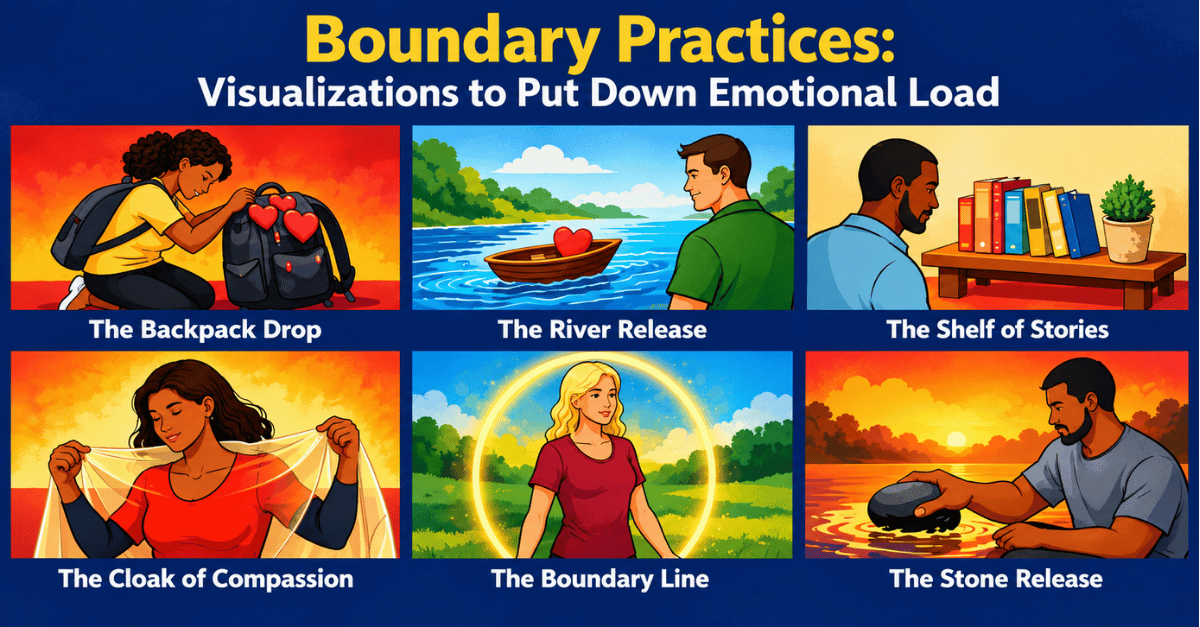
Boundary Practices — Visualisations to Put Down Emotional Load
The Backpack Drop — Imagine all the emotional weight you’ve picked up sitting in a backpack on your shoulders. Pause, take a breath, and picture yourself sliding it off and placing it gently on the ground. You don’t need to carry it any further.
The River Release — Visualise placing one heavy story or emotion into a small boat and setting it on a calm river. Watch it drift away at its own pace. You’re not pushing it; you’re simply letting it move on.
The Shelf of Stories — Picture a sturdy shelf beside you. When a story feels heavy, imagine placing it on the shelf — not discarded, not ignored, just stored where it belongs. You can return to it if needed, but it doesn’t have to sit inside you.
The Cloak of Compassion — Imagine wearing a light cloak that allows you to listen with empathy but prevents emotional absorption. When the day feels heavy, picture yourself unclipping the cloak and hanging it up. Compassion stays; the weight does not.
The Boundary Line — Visualise a soft, glowing line around your body. It lets kindness flow out and connection flow in, but it stops emotional weight from crossing into your inner world. You can listen fully without taking ownership.
The Stone Release — Imagine holding a smooth stone that represents one emotional load you’ve picked up. Feel its weight, acknowledge it, then place it down beside you. The story remains important — but it no longer sits in your hands.
A Final Word for Your Week
Emotional load is real, and it’s heavy.
But it’s also manageable when we name it, notice it, and practice putting it down.
- Your work asks you to listen deeply — and you do.
- Your work asks you to show compassion — and you do.
- Your work asks you to hold space for others — and you do.
But none of that requires you to carry their stories home.
Have a gentle, grounded week.
Watch the loads you carry.
And thank you — truly — for the service you offer others day in and day out.
If this perspective helps, or if you try one of these visualisations today, we’d love to hear what worked and what might need tweaking. ZestAgain grows stronger every time you share your lived wisdom.